A generational vision
The first generation begins far from Navarra. Guillermo Penso’s father, like so many others of his generation, left his homeland and travelled to Venezuela in search of new opportunities and new horizons. There he built much of his life, but he never lost his bond with the place that had watched him grow up.
In 1989 he decided to return. And he did so with a very clear idea: to give back to this land a part of everything life had given him.
That was when the family arrived in this corner of Navarra and found something they were not, in fact, looking for: a place of a beauty and a potential impossible to ignore. A singular microclimate, sheltered by the Sarbil mountains; a historic winery built in 1840; and a winemaking tradition that had been interrupted for almost a century.
“The vineyard chose us,” Guillermo would say years later.
And so Otazu began.
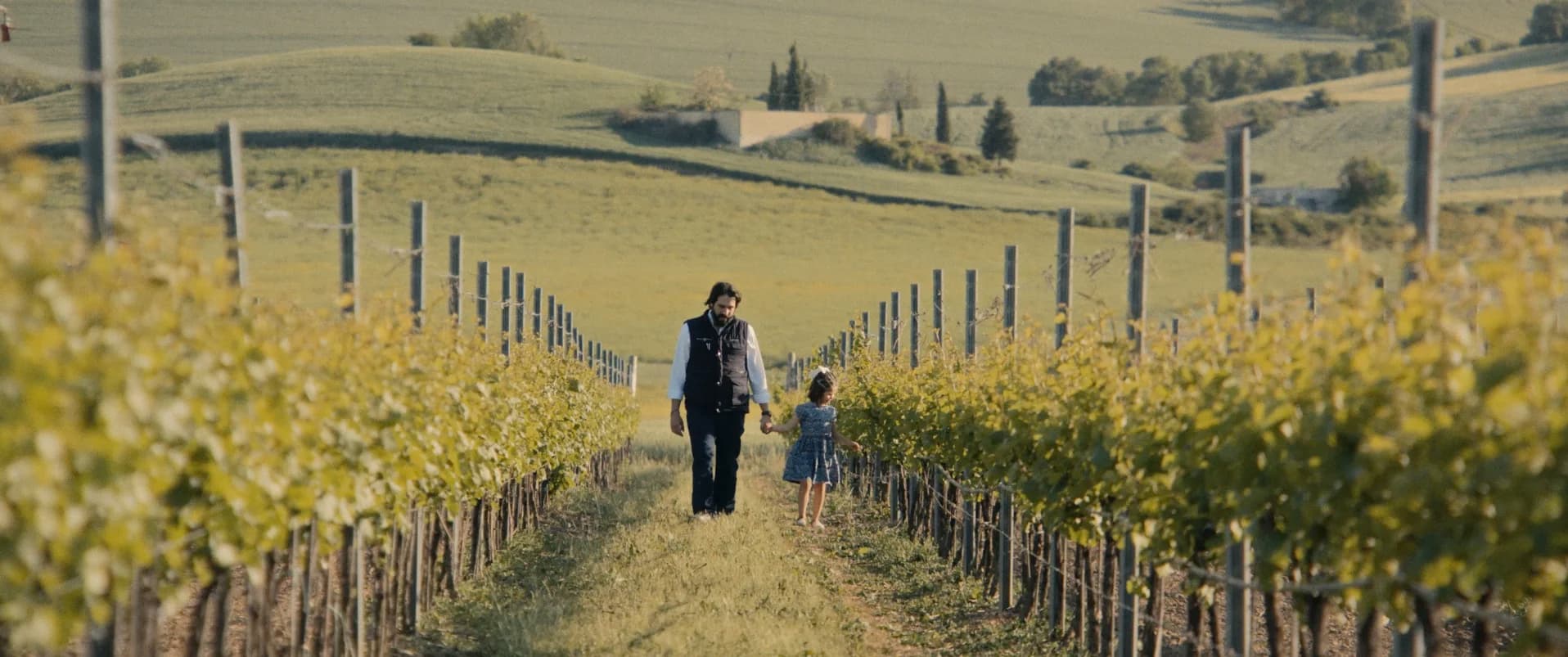
That first generation recovered a story that had come to a halt in 1890. The vineyard was replanted, the winery was restored, and a project began to take shape that, from its very origins, aspired to be far more than a winegrowing estate. It was a way of recovering the past in order to build something that could outlast those who had started it.
With the arrival of the second generation, Otazu began a new stage. Guillermo Penso —a nanotechnology engineer, MBA from HEC Paris and Tsinghua, and with training in philosophy— took on the challenge of carrying that legacy into the 21st century.
His vision was to widen the meaning of Otazu: to understand that wine could not be separated from the land that produces it, nor from the culture, the thought, the architecture and the art that surround it. Under this vision, Otazu obtained recognition as the Protected Designation of Origin Pago de Otazu in 2009, created the Otazu Foundation in 2016 and received the ARCO “A” Award for Collecting in 2020. Art stopped being something that merely accompanied the wine and became part of the very identity of the project.
Today, while the second generation continues writing this story, the third is already starting to put down roots of its own at Otazu.
It does so in a particularly symbolic way, through Viña Pía, the vineyard that bears the name of Pía, Guillermo’s daughter, and which stands for the continuity of a family that understands Otazu not as something it owns, but as a legacy it receives, cares for and hands on to the next generation.
And it is precisely from that vineyard that Berués is born, a historic Navarrese variety that had all but disappeared, and which Otazu has recovered after years of work. Its return has something deeply bound up with our own story: a variety that belonged to this land, that one day vanished from it and that, generations later, puts down roots again in the place it belongs to.
That is why Berués is much more than a new wine.
It is the wine that came home.
In a way, its story also reflects that of the family: someone who one day set out in search of new horizons, returned to Navarra to give something back to the land that had watched him grow up, and began a project that today reaches three generations.
Because Otazu is a story that is passed on, a land that is recovered and a legacy that evolves.
Three generations. One same land. And a story that is only just beginning.