Menu

Monumental Art Biennial

Otazu Foundation

A new sculpture in the landscape

Each edition, the Otazu Foundation invites four contemporary artists to imagine a monumental work for the setting of the winery. An international jury chooses one of them, which then rises on the ground and stays for good in the collection and in the landscape of the estate.

2016

I Monumental Art Biennial

A biennial conceived between landscape and form

The first call grew out of a 2014 conversation between Guillermo Penso, president of the Foundation, and the artist Carlos Cruz-Diez, and it set the rules of the award: four invited artists, one specific corner of the estate and an international jury deciding which of the four works would rise.

The 2016 edition looked at the space that opens between the 12th-century Romanesque church and the 14th-century dovecote tower. Per Barclay, María Loboda, Sergio Prego and Alfredo Jaar each imagined a piece for it, and the jury went for Jaar's: The Colour of Our Lives — water, light and glass.

Text by Miguel Ángel García Vega, curator of the Award.

JuryJoão Fernandes (chair), Soledad Lorenzo and Aníbal Jozami.

Alfredo Jaar — The Colour of Our LivesSelected work

Alfredo Jaar

Santiago de Chile, 1956

The Colour of Our Lives

How can a work of art respond to a sublime landscape? How can it reflect, articulate, illuminate and engage with the perfect process of making the wines of Otazu?

My proposal consists of three glass cubes of different sizes, corresponding to the production of red, white and rosé wine at the Otazu estate. Each cube is filled with purified water free of toxic agents and, at its base, below ground, sits a computer-controlled LED lighting device.

From that device an operator can set the exact colour of each cube, matching it to the wine of the harvest at any given moment, in all its chromatic richness. The system lights the cubes day and night and creates a light sculpture of great visual power.

With this work my intention is to match the science and the rigour, but also the sophistication, the clarity and the perfection of the process of making the wines of Otazu.
The other visions

Per Barclay — Otazu Glass Pavilion

Per Barclay

Noruega, 1955

Otazu Glass Pavilion

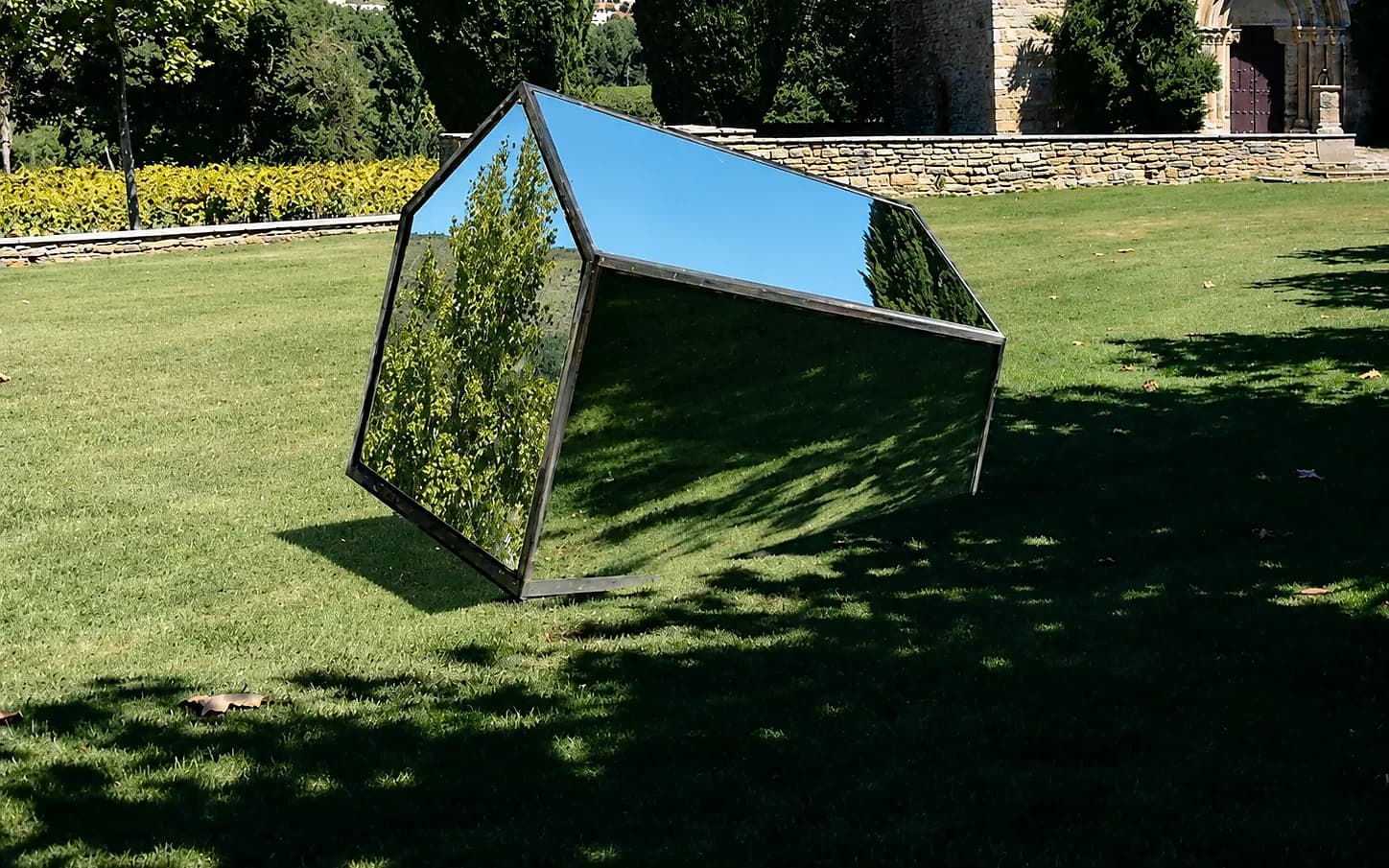
The proposal is a stainless-steel structure, an archaic form: a house. The light, a warm yellow, draws a glowing outline in the darkness.

The Glass Pavilion will be partly buried in the ground, as if growing out of the earth of Otazu. The stainless-steel structure is clad in semi-transparent glass: you can see the interior and, at the same time, the landscape through the sculpture, while the sky is reflected on the walls and the roof.

Inside, following the frame, tubes with LED lights about three centimetres in diameter run along the steel structure. The light, a warm yellow, draws a glowing outline in the darkness.

María Loboda — This Work Is Dedicated to an Emperor

María Loboda

Polonia, 1979

This Work Is Dedicated to an Emperor

I propose an intervention in the landscape of Otazu consisting of a forest of conifers that changes position weekly or monthly. The work sits between sculpture and performance: a sculpture in the process of changing, a nomadic sculpture.

The proposal is inspired by lines from Shakespeare's Macbeth and by a group of American landscape architecture students close to Garrett Eckbo (1921-2000). I have prepared a provisional plan of movements covering ten displacements, which would be the equivalent of ten months or weeks.

The movement would span the whole area of the winery from one side to the other. Once the trees have reached and conquered the ground, the movement would be reversed and they would return to the starting side. The trees should stand close to one another and be moved in the evening, after the visitors have gone, to underline the autonomous, ghostly manoeuvre.

Sergio Prego — Liquid Wake (Sprawl)

Sergio Prego

Guipúzcoa, 1969

Liquid Wake (Sprawl)

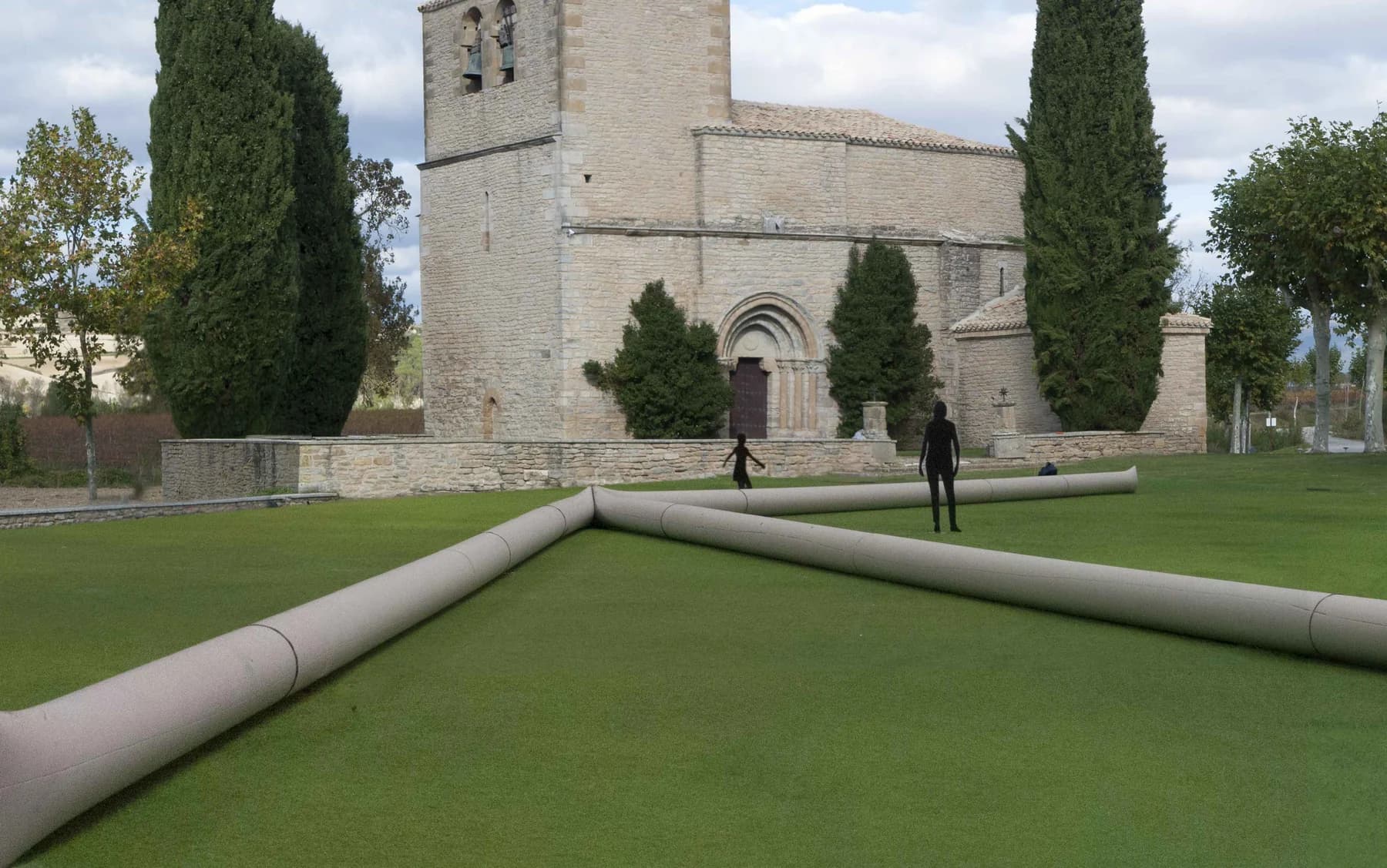
The structure is clear: three light grey or white reinforced concrete cylinders, 40 centimetres in diameter. The purpose is to articulate a place architecturally, respecting the identity of the existing architecture and the beauty of the landscape.

The cylinders are cast using flexible membrane formwork and measure 17.5, 20 and 22.5 metres long. The intervention gives substance to the space between the buildings with a non-intrusive proposal that organises occupation and movement.

The shape of the cylinders comes from the material process itself: the internal pressure exerted by liquid concrete inside the flexible formwork. At 40 to 60 centimetres high, they can be sat or lain on and, at the same time, crossed or stepped over at any point. The arms unfold from the centre along three axes that divide the trapezoidal plot into as many unequal sections.

2017–2018

II Monumental Art Biennial

A biennial to rethink the story of an age

The second edition framed the award as the story of an age: art understood as a narrative that interprets the world and that, at Otazu, engages with a place where nature and history have been in conversation for centuries.

The four invited artists walked the vineyard before imagining their piece for a specific site of the winery: Pedro Cabrita Reis, Roman Ondak, Damián Ortega and Asier Mendizabal. The jury went for Crudo zarzo, by Mendizabal.

Text by Miguel Ángel García Vega, curator of the Otazu Foundation Monumental Art Biennial Award.

JuryManuel Borja-Villel (chair), Julieta González and Guillermo Penso.

Asier Mendizabal — Crudo zarzoSelected work

Asier Mendizabal

Ordizia, 1973

Crudo zarzo

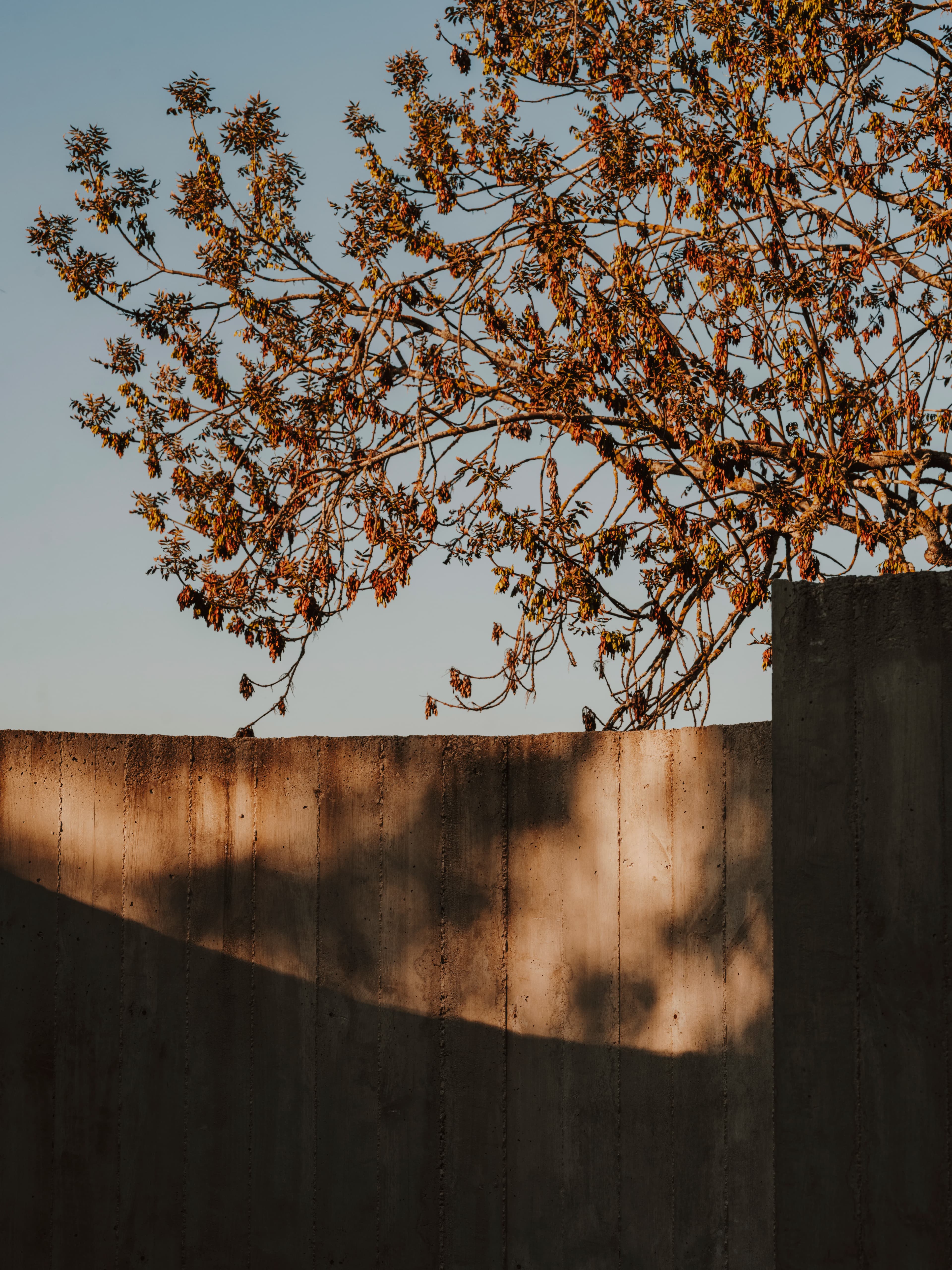
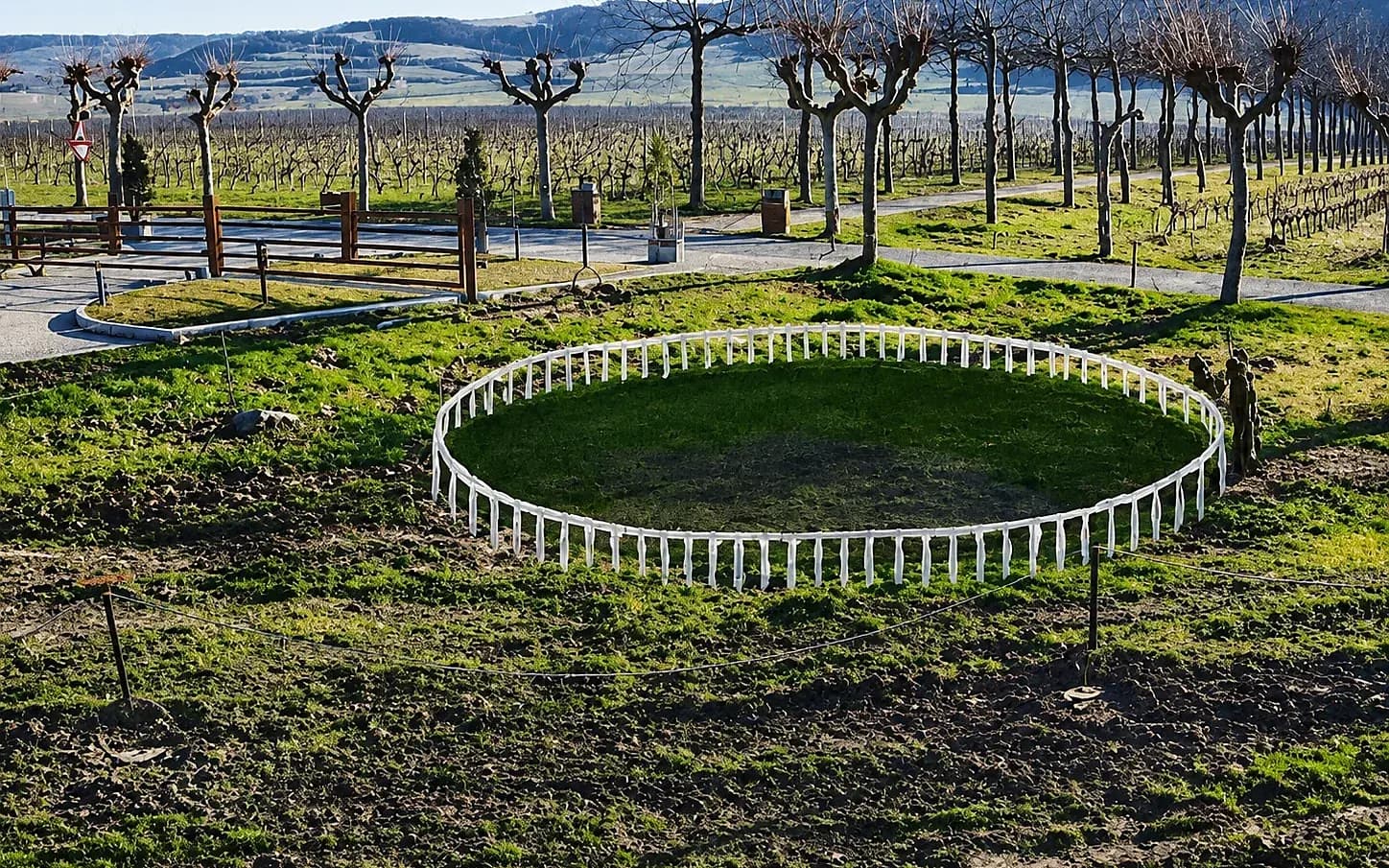
I propose building a circular fence to serve as formwork for a concrete pour that will take the shape of the woven branches and produce a texture between the organic and the geometric.

The sculpture will largely be the result of a technical process. The rudimentary technology of weaving rods, usually hazel, to build fences goes back to the dawn of time and recurs across cultures.

The site of the piece has the peculiarity of making two sets of parallel lines converge, formed by the vines planted in straight rows in each of the neighbouring fields. Those lines remind us that the landscape we tend to naturalise as an essential sign is, far more than we intuitively perceive, a cultural landscape: even the morphology of the vine itself is the product of cultural transformation.

In its hollow semi-cylindrical structure, the concrete sculpture will create a strange interior space from which, through a tube, only a section of the landscape can be seen — making its geometric nature evident.

The other visions

Pedro Cabrita Reis — A Garden for Otazu

Pedro Cabrita Reis

Lisboa, 1956

A Garden for Otazu

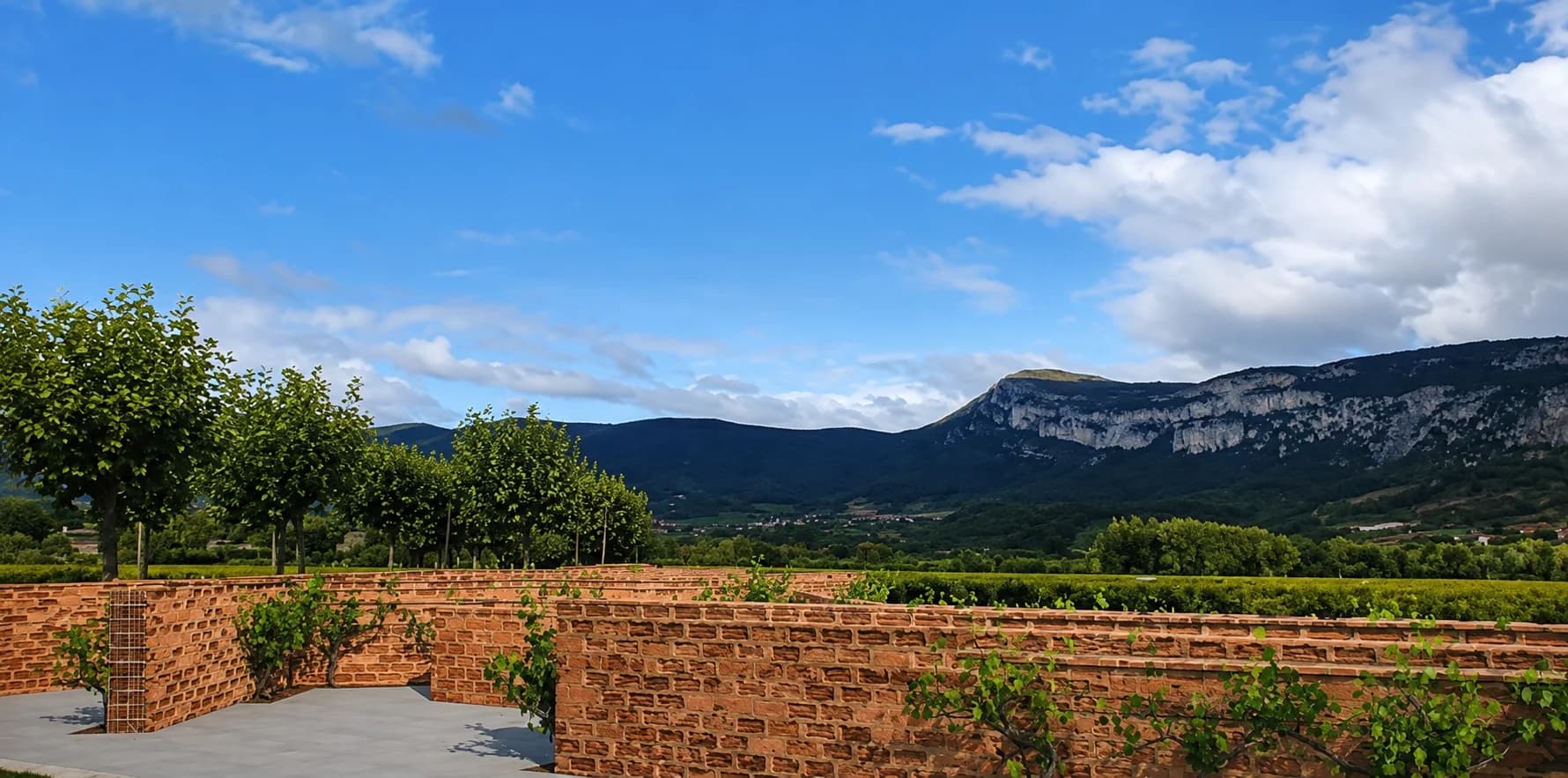
Brick walls rise in this garden, asserting the transformation of the landscape by human hands. The intervention is made up of four essential elements: the concrete slab, a bench, the walls and the vines.

In a landscape transformed by man, the regular pattern of the vineyard dominates the horizon. A vineyard is a garden, and a garden can be a labyrinth, an enclosed space, a place of contemplation and reflection. The vine will grow organically over the walls.

On the concrete slab, set into the ground, brick walls are built so as to create a labyrinth. They will be 40 centimetres thick and between 1.20 and 1.50 metres high, sculpted to look like ruins, rubble from another time. A brick bench will be built beside the path and a drip irrigation system will be installed to supply the whole vineyard.

Roman Ondak — The Inside of a Hill

Roman Ondak

Žilina, 1966

The Inside of a Hill

This «negative» sculpture offers a view of the hill from ground level down to its depths. A dry oak stump with intact roots would be found for the installation, invisible to the viewer.

The intention of the project is to use local elements typical of the area: the soil and the way humans shape the landscape using its resources. On the chosen site a cone-shaped pit would be dug, with a top circle 800 centimetres in diameter and 400 centimetres deep at its central axis. A hole of this shape alludes to the form of a hill that seems to be turned upwards and inwards.

If we imagine a real hill with an oak on top — the conceptual source of this installation — the roots of the tree inside the ground would be invisible to the viewer; but in this inverted context they would be the only visible part of the oak, as if seen from within.

Damián Ortega — Mimetic Obelisk

Damián Ortega

Ciudad de México, 1967

Mimetic Obelisk

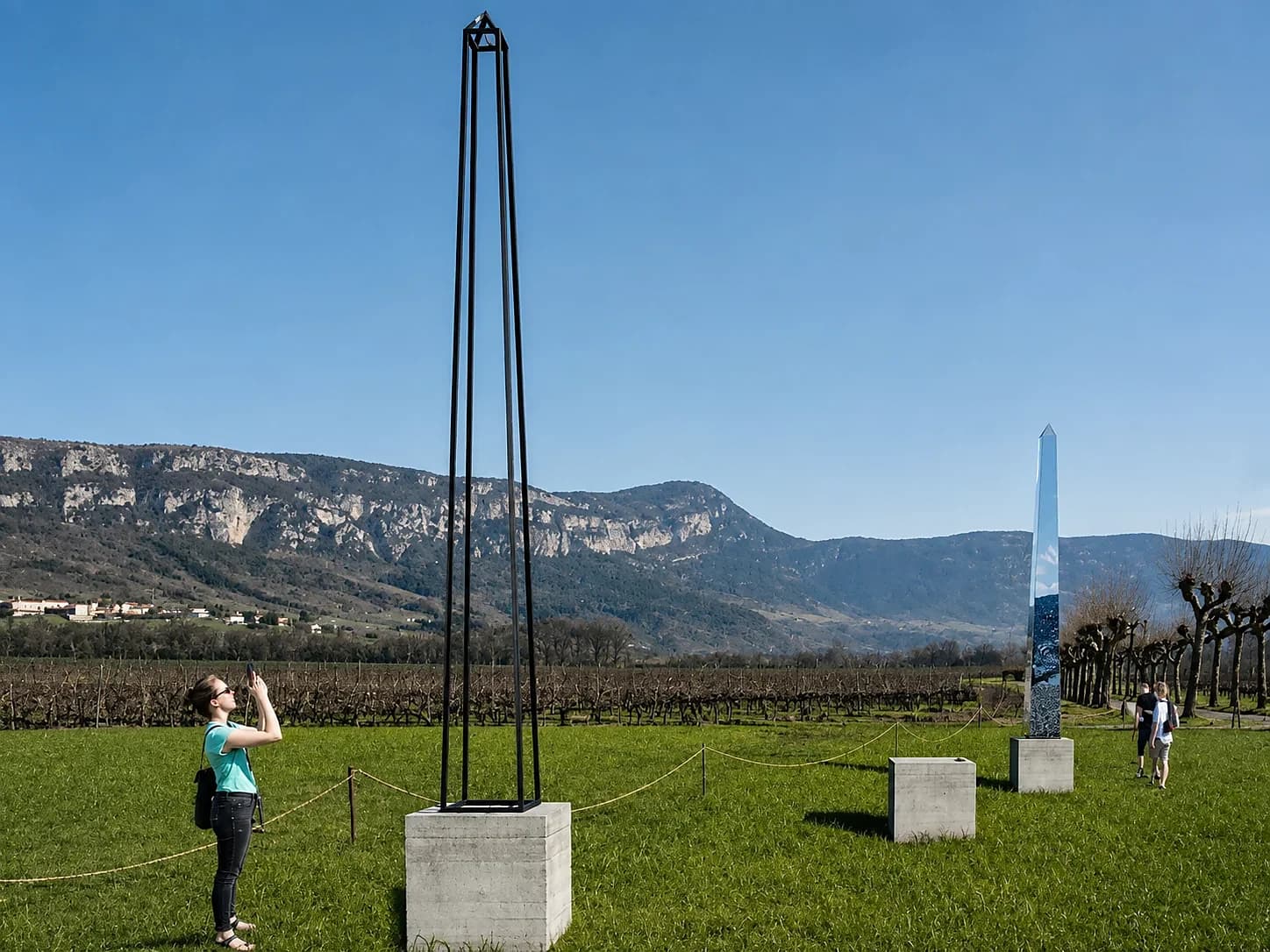
The piece consists of three obelisks over six metres high, shown in an open space. An installation that asks its own questions and looks for its own answers: how do you intervene in a space that does not need us?

Although the origin or specific function of the obelisk is not known for certain, it is assumed that these monumental blocks of stone worshipped the sun. Their origins can be traced to Egypt. The obvious phallic symbol has been no secret to anyone, and the obelisk also became a key piece in the reshuffling of world powers: owning or appropriating one was a demonstration of a ruler's, a politician's or a soldier's might.

The contemporary reinterpretation of power and sexuality sets us the difficult task of rethinking the presence, the monumentality and the intention of public sculpture. This is an exercise in three stages on the disappearance of a monument: how do we set aside the centralist, verticalist dominance of the world? How do we make a monument a receiver rather than an impostor? How can it engage more fraternally with its space?

2019

III Monumental Art Biennial

A biennial to rethink the relationship between nature and culture

The third edition brought together four creators of very different backgrounds around one idea: the point where time, nature and culture converge. Otazu offered them a physical space and they turned it into ground on which to sow ideas.

Answering the call came Íñigo Manglano-Ovalle, with the arithmetic of a column of dodecahedrons; Rita McBride, a revisiting of Marinetti's futurism; Pedro Reyes, the Mesoamerican god of wine returning to the land he came from; and Hans-Peter Feldmann won with Time, a half-buried clock that claims the time of nature over the time of clocks.

Text by Miguel Ángel García Vega, curator of the Otazu Foundation Monumental Art Biennial Award.

JuryManuel Borja-Villel (chair), Gabriel Pérez-Barreiro, Guillermo Penso, Sofía Mariscal and Marilise Ilhesca Jozami.

Hans-Peter Feldmann — TimeSelected work

Hans-Peter Feldmann

Düsseldorf, 1941–2023

Time

Man has often tried to describe time, to control it, to grasp its meaning and to interpret it. We can measure time with calendars and instruments, but we always depend on real time: natural time.

Nature regulates everything; it is our great teacher. Plants and fruit show us every year how change follows change, how time passes. In this way the course of the year can be seen clearly in the vineyards: the vines, which again and again grow new leaves, let the grapes ripen slowly until they reach maturity.

Giving time is the central question in the art of winegrowing. No sophisticated instrument can replace the best winegrower's knowledge in deciding when the moment to harvest has come; in the same way, only he knows the optimal process for fermenting grapes into wine. The time winegrowers work with is not the time of clocks or calendars, but the time of nature itself.

The proposed work is a sculpture: a clock roughly 2 metres in diameter, set into the ground and tilted. The clock always shows the same hour.

The other visions

Íñigo Manglano-Ovalle — A Not So Private Sky

Íñigo Manglano-Ovalle

Madrid, 1961

A Not So Private Sky

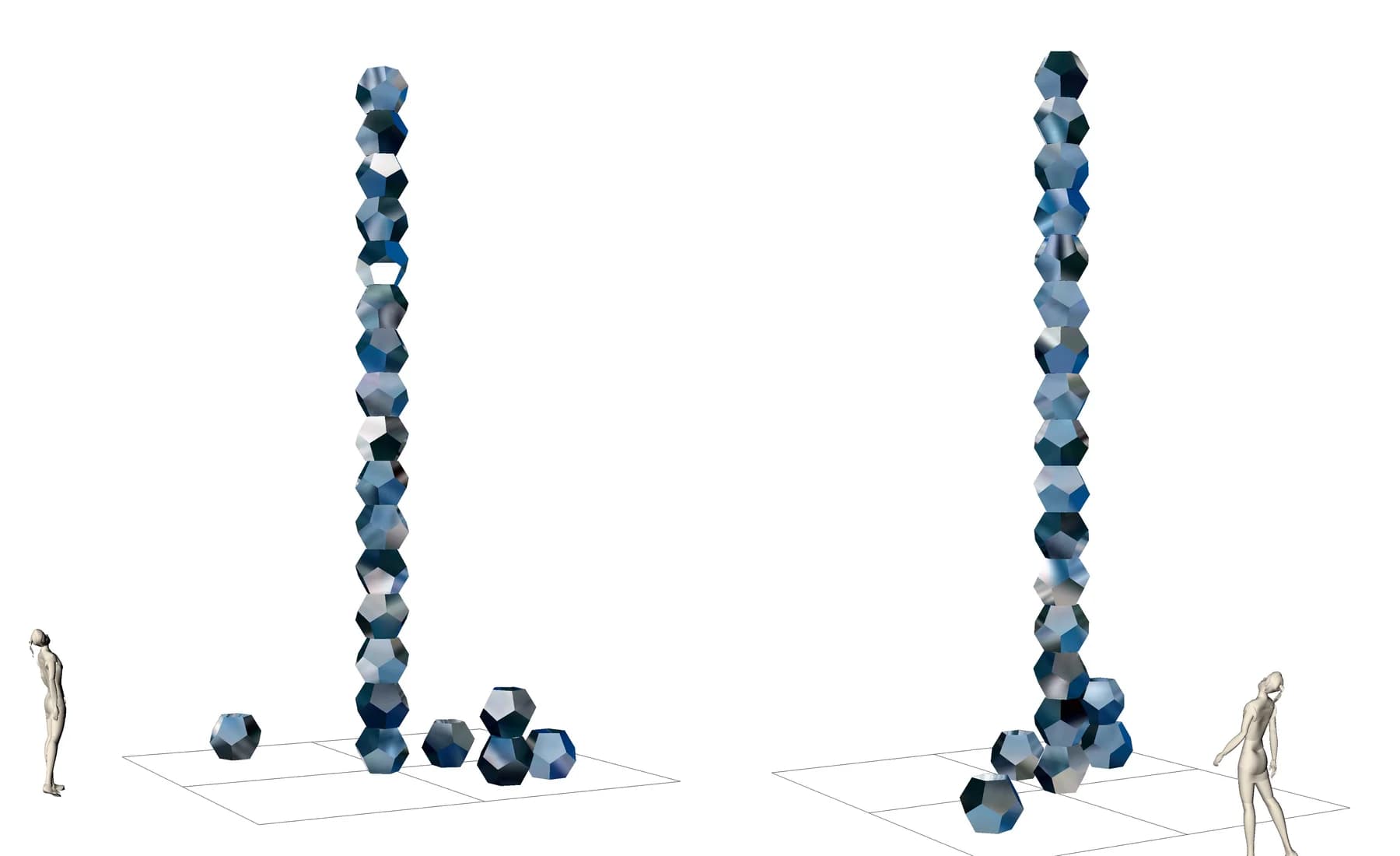
«A Not So Private Sky» calls for a social commitment to the environment, seeing the world as a common, shared place. The sculpture is conceived as a tribute to everyone who has devoted their life to studying the infinitely small and the infinitely large.

Sixteen dodecahedrons are stacked one above the other to a height of 8 metres. As they are stacked, each component rotates slightly from the one before, creating a subtle vertical spiral. At the foot of the column five more dodecahedrons rest, as if fallen or waiting to be placed in formation, reflecting the sky and the landscape as the viewer walks around it.

The minimalist look of the sculpture conceals the complexity of its geometry, as has happened throughout history with philosophical, scientific and artistic ideas. The column draws a straight line from the ground to the sky, as if trying to connect both dimensions: ground and sky connected ask the viewer for a commitment, not only individual but also as a member of a collective.

Rita McBride — Clean Slate

Rita McBride

Des Moines, 1960

Clean Slate

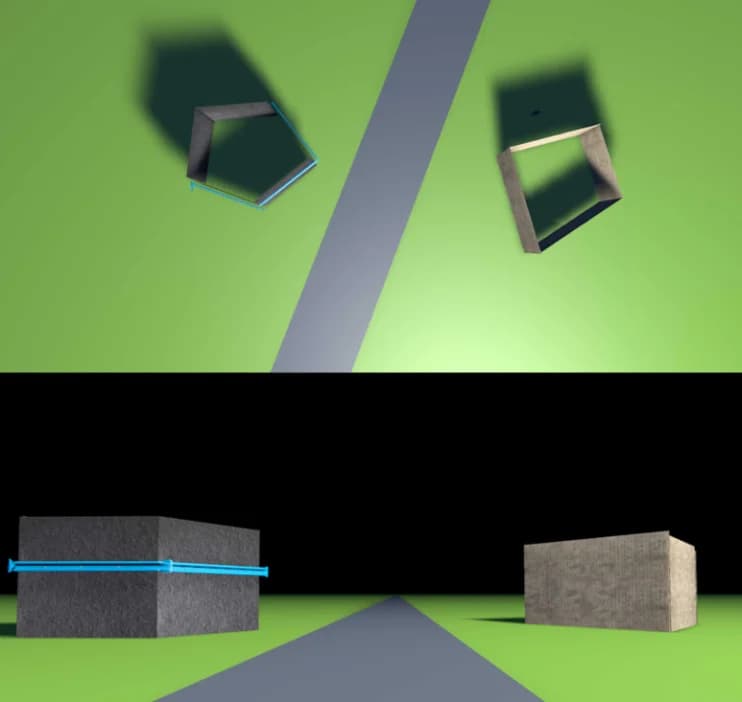
«Clean slate» refers to the philosophical notion of tabula rasa, which holds that at birth the mind is free of prejudice and parameters. Slate is valued for its resistance to fire and water, and for letting us write, erase and start again.

The work consists of a pentagon of slate sheets and five guide rails installed at the horizon line. Guide rails belong to that category of functional objects we normally perceive only at the periphery of our existence. They are nevertheless essential: they let us navigate the world and follow a trajectory.

With the arrival of Futurism, and Marinetti in particular, the idea of the object in motion was elevated: speed and momentum became synonymous with beauty. Objects in motion are separate neither from other objects nor from their surroundings; they seem to merge and blend with each other and with the landscape. The work reflects on that movement and that sense of convergence: how a journey becomes an experience of geometry and speed, which is in fact the structure of our own experience of the world.

Pedro Reyes — Chac Mool

Pedro Reyes

Ciudad de México, 1972

Chac Mool

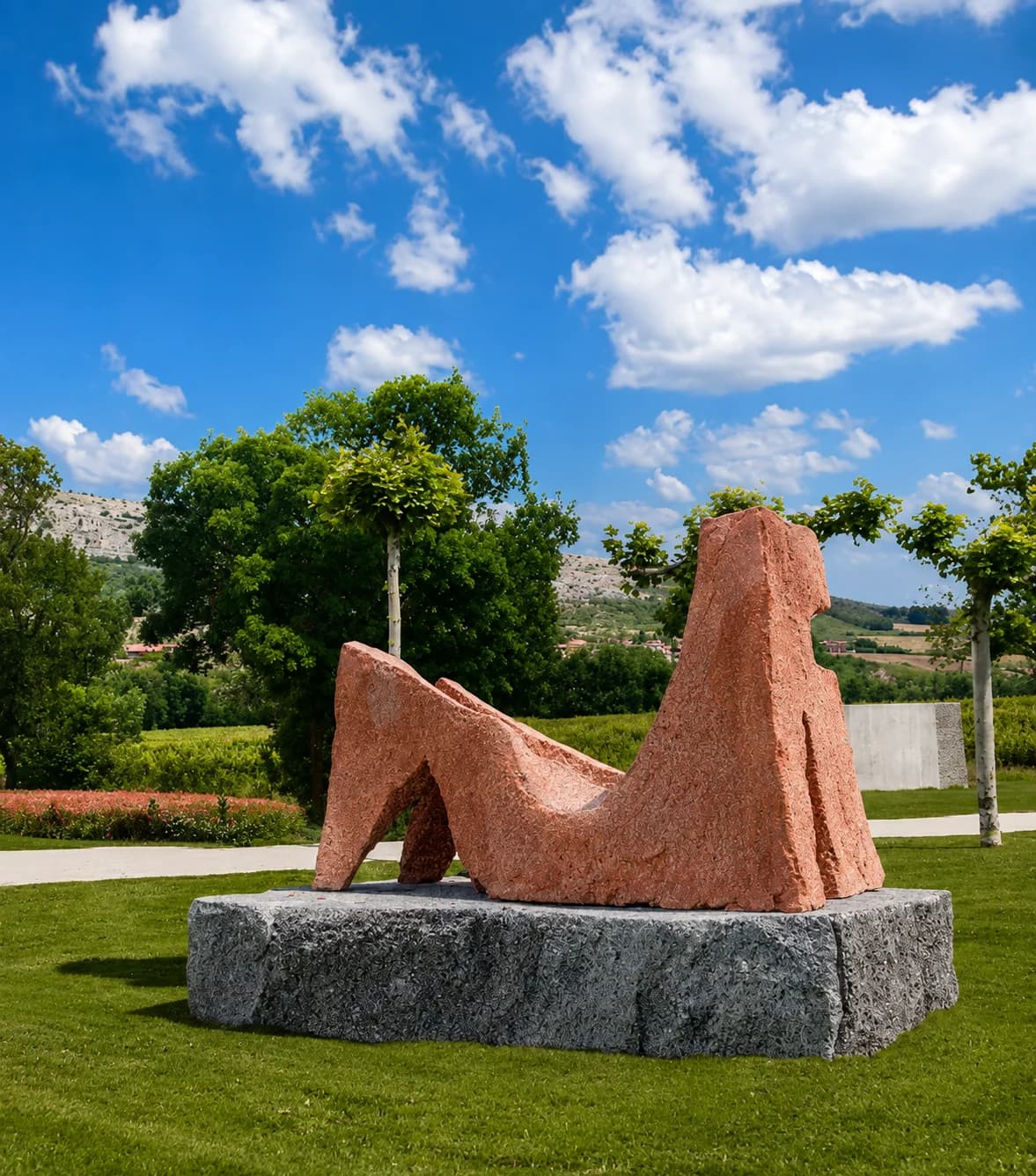
Dionysus or Bacchus is present on the European continent. The Chac Mool is considered his equivalent on the American continent. The reclining figure has always been a subject of sculpture.

The Chac Mool is a reclining figure that seems either to have drunk already or to be waiting for its cup to be filled. Chac Mools are depicted again and again in Maya culture.

Otazu, through its ties with Latin America, is an ideal landscape in which to raise a modern Chac Mool: a family with American roots celebrating the arrival of the god of wine in a European country. The Chac Mool seems to wait for his cup to be filled in order to shower good fortune and blessings on everyone living on the estate.

2027 · Coming soon

IV Monumental Art Biennial

The fourth edition will be unveiled in 2027. The selected work, conceived for the outdoor setting of the estate, will then stay in the collection and in the landscape of Otazu.

Próximamente — Work to be unveiledComing soon

Próximamente

Work to be unveiled

The name of the artist and the selected work will be revealed ahead of the 2027 unveiling.

The works selected in each Biennial stay at Otazu, alongside more than 150 contemporary artworks spread across the estate, the winery and the vineyard.

Explore Art & Culture